Which Airlines Mishandle the Most Luggage?


Key Data Points
- Every year, the U.S. Department of Transportation (DOT) releases an annual report on how airlines performed during the previous calendar year.
- Our review of data from the past year found that travelers may be at a proportionally higher risk for lost, damaged, or delayed luggage when traveling on certain airlines in the United States.
- 2025 DOT data shows that United Airlines and its regional subsidiaries recorded the highest rate of mishandled baggage among U.S. carriers last year.
- When reviewed on a 5-year basis, historical data shows that Hawaiian Airlines and United Airlines are repeatedly some of the worst performers, with incidents of baggage mishandling rising by nearly 135% and 60% versus 5 years prior.
- Surprisingly, all five of the best-performing airlines last year were low-cost carriers, each outperforming larger legacy airlines on baggage handling.
- Allegiant Air was the airline with the best baggage handling in 2025, recording the lowest rates for mishandled luggage among U.S.-based airlines.
- Southwest Airlines also stands out as a top performer with some of the highest passenger and baggage volume in the nation but very low incident rates compared to major airlines.
- As context for this data report, increasingly restrictive baggage policies and new pricing structures like basic economy are forcing travelers to check their bags at higher rates than before.
- This data serves as a practical guide when choosing an airline, and highlights why baggage insurance may be your best option to protect your belongings.
U.S. Airlines Ranked By Mishandled Baggage Rates
Our team reviewed airline baggage data from the U.S. Department of Transportation to determine which airlines rank as best and worst for travelers checking luggage.
The DOT defines “mishandled” luggage as any incident of lost, delayed, damaged, or pilfered luggage while under the airline’s custody.
Below is the full list of major U.S. carriers and airline networks ranked from worst to best for luggage handling.
| Rank | Carrier | Bags enplaned | Bags mishandled | Mishandled bags per 100 enplaned |
|---|---|---|---|---|
| 1 (worst) | United Airlines Network | 77,202,605 | 552,263 | 0.72% |
| 2 | American Airlines Network | 110,342,175 | 723,025 | 0.66% |
| 3 | Hawaiian Airlines | 6,330,439 | 34,346 | 0.54% |
| 4 | Alaska Airlines Network | 28,082,972 | 145,786 | 0.52% |
| 5 | Delta Air Lines Network | 102,377,406 | 436,502 | 0.43% |
| 6 | Spirit Airlines | 7,712,106 | 33,384 | 0.43% |
| 7 | Frontier Airlines | 9,624,115 | 39,692 | 0.41% |
| 8 | Southwest Airlines | 109,339,609 | 418,350 | 0.38% |
| 9 | JetBlue Airways | 13,680,675 | 42,997 | 0.31% |
| 10 (best) | Allegiant Air | 6,355,382 | 5,595 | 0.09% |
Below we have broken these rankings down into an analysis of which airlines performed best, which performed worse, and what the data says about certain carriers and their operations.
5 Best Airlines For Luggage Handling
When looking at all of the data points available to us, Allegiant stands out as the overall top performer for checked baggage handling among U.S. carrier groups.
The 5 best airlines for luggage handling in 2025 were:
- Allegiant Air
- JetBlue Airways
- Southwest Airlines
- Frontier Airlines
- Spirit Airlines (now defunct)
Surprisingly, all of the top-performing airlines for baggage handling from the past year are budget or low-cost carriers. Although the majority of these airlines handle fewer bags, that wasn’t the case for all of them.
As an example, Southwest Airlines ranks 4th in the nation in passenger volume and 2nd in the number of checked bags, roughly 32 million more than United and 7 million more than Delta.
Yet, despite that volume, Southwest had the 3rd lowest rate of mishandled bags among U.S. carriers in 2025.
The 5 Worst Airlines For Luggage Handling
Our analysis found that the five worst airlines for mishandled luggage include:
- United Airlines Network
- American Airlines Network
- Hawaiian Airlines
- Alaska Airlines
- Delta Airlines Network
It may not come as a shock to many that some of the largest U.S. airlines top this list, but what is interesting about this data is that mishandled luggage rates do not seem to coincide with passenger volume.
For context, here is a look at passenger volume for major airlines in 2025:
| Airline | 2025 Passenger Volume | Ranking for Mishandled Luggage (Worst) |
|---|---|---|
| American Airlines | 223,540,000 | 2nd |
| Delta Air Lines | 200,000,000 | 5th |
| United Airlines | 181,053,000 | 1st |
| Southwest Airlines | 168,334,000 | 8th |
| Alaska Airlines | 58,627,000 | 4th |
| JetBlue Airways | 39,336,000 | 9th |
| Frontier Airlines | 33,200,000 | 7th |
| Spirit Airlines (now defunct) | 32,031,000 | 6th |
| Allegiant Air | 18,518,653 | 10th |
Note: The passenger volume figures above are for supporting context only and were not used to calculate the baggage handling rankings.
While American Airlines is the exception, the larger data set confirms that servicing more passengers and more bags doesn’t by itself produce a higher mishandling rate.
United Airlines, for example, ranks 3rd for total passenger volume, but 1st for rate of mishandled bags, while Delta Airlines ranks 2nd for passenger volume, but 5th for mishandled bags.
Southwest and JetBlue are even greater examples of this trend, ranking 4th and 6th for total passengers, but 8th and 9th out of 10 for mishandled bags, respectively.
This data shows that successful baggage handling appears to have less to do with the number of bags, and more to do with extraneous factors.
Historical Data On Baggage Mishandling
When looking at the industry as a whole, the data shows that baggage handling rates in 2025 are improving versus peak incident rates in 2022 and 2023.
| Year | Mishandled Bags per 100 |
|---|---|
| 2021 | 0.51 |
| 2022 | 0.64 |
| 2023 | 0.58 |
| 2024 | 0.55 |
| 2025 | 0.52 |
This is largely driven by improved bag tracking and technology enhancements like compatibility with Apple Find My and Google Find Hub, as well as greater communication across airlines. Sources note that 2022 saw record rates of mishandled bags due to an influx of post-pandemic travelers and staffing shortages.
This data was also influenced by the massive systemwide meltdown in 2022 caused by winter storms, which wreaked havoc on Southwest Airlines’ outdated infrastructure and stranded millions of passengers and their bags.
Most Improved Airlines
Of the ten airlines on our list, we analyzed which airlines improved and which worsened over the past 5 years.
The chart below shows that 6 major airlines have managed to improve their incident rates for mishandled bags versus where they stood just 5 years ago.
Note that in the chart below, a decline represents an improvement.
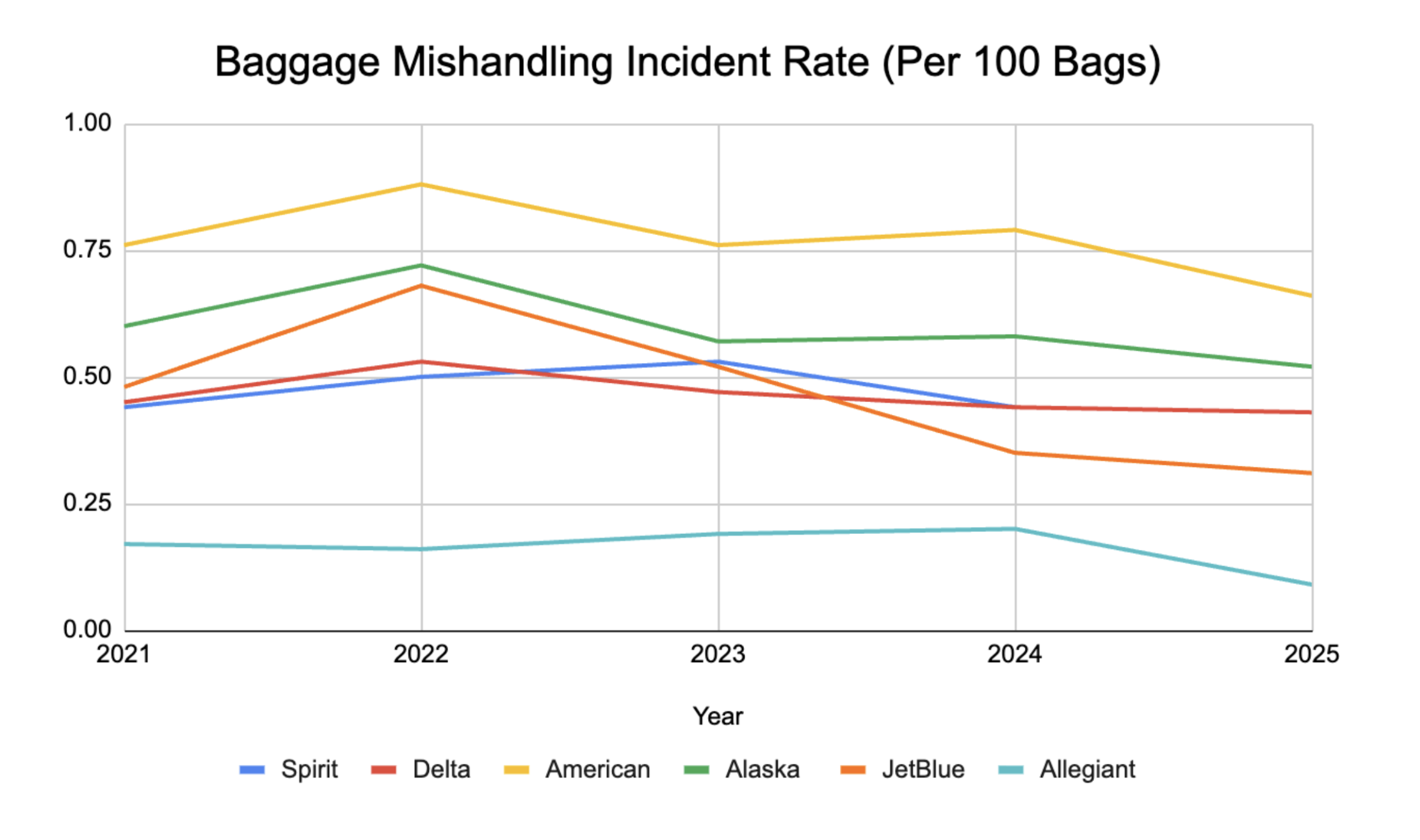
When comparing 2021 to 2025 incident rates, the airlines with the greatest reduction in mishandled bags were:
- Allegiant: -47.06% reduction
- JetBlue: -35.42% reduction
- Alaska: -13.33% reduction
- American Airlines: -13.16%
Of these, JetBlue shows the highest rate of improvement, slashing mishandled bags by over half (-54%) versus its all-time high in 2022.
Worsening Airlines
Four major airlines have failed to improve baggage handling rates when compared against 2021 data (5-year data).
The chart below shows that in the past 5 years, mishandled bags have increased significantly for airlines like United, Hawaiian, Frontier, and Southwest.
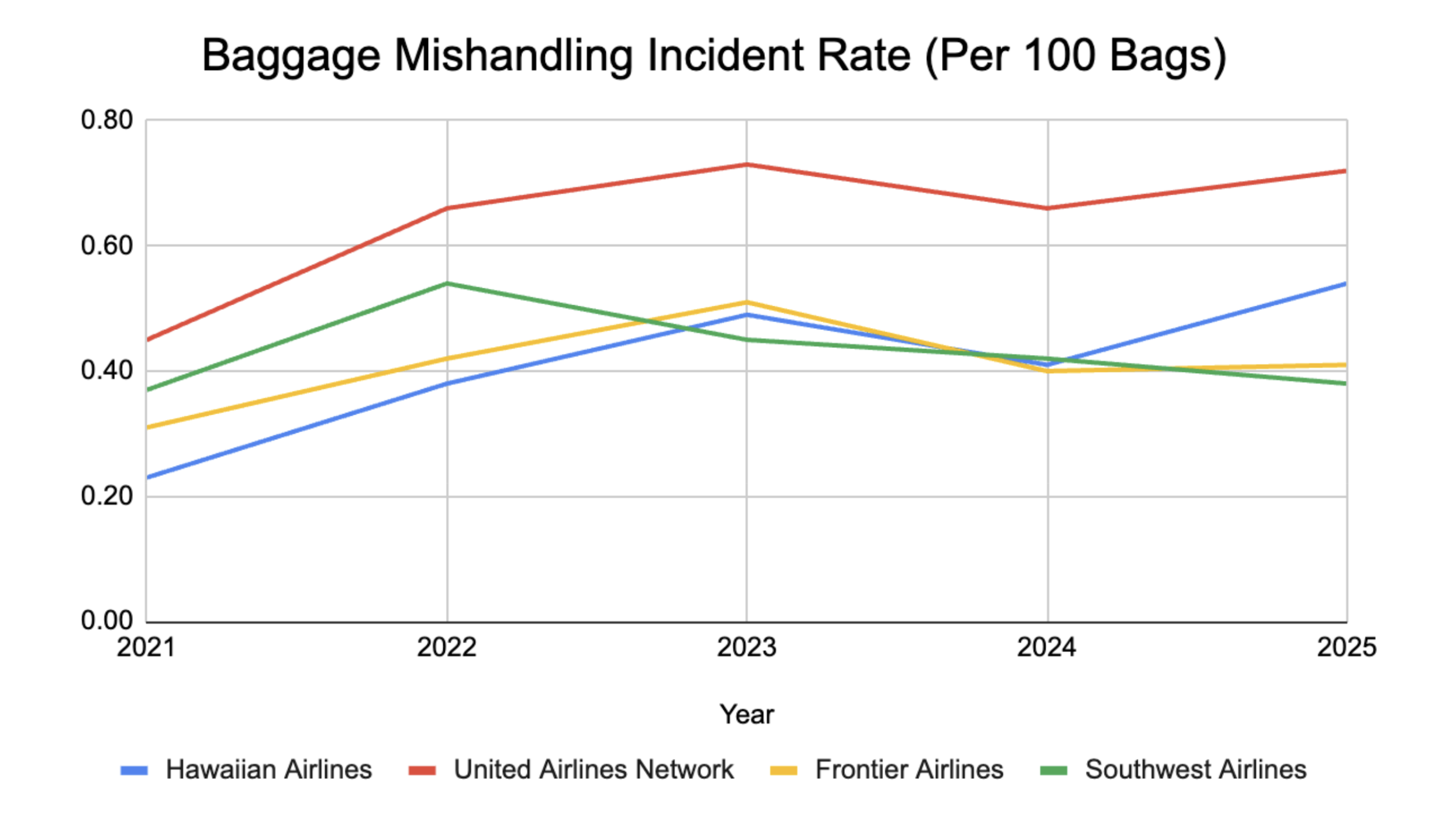
Over the past 5 years:
- Hawaiian Airlines has progressed the least, with incident rates for mishandled bags rising by 135%.
- United Airlines, which also ranks as the worst airline for baggage handling in 2025, had incident rates for mishandled bags rise by 60%.
Why This Data Matters for Travelers
With the rise in restrictive airline baggage rules, more travelers than ever before face a statistically higher likelihood of experiencing lost, delayed, or damaged baggage.
Rising jet fuel prices, increased government oversight, and other factors are increasing pressure on airline profit margins, which has led every major carrier to implement new fare structures such as basic economy and stricter in-cabin baggage rules.
In many cases, travelers are now required to pay to check their bags, where previously they would have been allowed to carry them on for free.
With worsening baggage handling rates seen on several major airlines, it begs the question: are travelers paying for a poorer service?
The chart below shows our analysis of baggage policies on major U.S. Carriers:
| Airline | Domestic Carry-on | Domestic Checked | International Carry-on | International Checked |
|---|---|---|---|---|
| United | 0 carry-on 1 personal | 0 free | Trans-Pacific/Atlantic/S. America: 1 carry-on, 1 personal Elsewhere: 0 carry-on, 1 personal | 1 free on trans-Pacific routes 0 free elsewhere |
| American | 1 carry-on 1 personal | 0 free | 1 carry-on 1 personal | 1 free on AUS/NZ; 1 free on Asia/India/Qatar 0 free elsewhere |
| Delta | 1 carry-on 1 personal | 0 free | 1 carry-on 1 personal | 1 free on Asia/Pacific routes 0 free elsewhere |
| Alaska | 1 carry-on 1 personal | 0 free | 1 carry-on 1 personal | 0 free |
| Southwest | 1 carry-on 1 personal | 0 free | 1 carry-on 1 personal | 0 free |
| Hawaiian | 1 carry-on 1 personal | 0 free | 1 carry-on 1 personal | 0 free |
| JetBlue | 1 carry-on 1 personal | 0 free | 1 carry-on 1 personal | 1 free on transatlantic 0 free elsewhere |
Note: The above data was correct at the time of research; information is subject to change.
On Domestic routes, no basic economy fare offers free checked luggage. The same is the case on the majority of international routes.
The strictest is United Airlines, which only allows a single personal item on domestic flights, and no free carry-on. Unsurprisingly, United also ranks as the worst-performing airline for baggage handling in 2025 and has seen incident rates rise over the past 5 years.
Why Travel Insurance May Be Your Best Option
With increasingly restrictive baggage policies, the likelihood of needing to pay for a checked bag is higher than ever, and although current DOT regulations require airlines to compensate passengers for mishandled baggage, there are certain caveats and loopholes.
Reimbursement and replacement are still subject to each airline’s policy, and in many cases, airlines will offer to replace damaged luggage by allowing travelers to choose from a list of set baggage, which may not match or exceed the value of your damaged luggage.
“JetBlue damaged my luggage a few years back. One of the corners was busted, and a wheel didn’t spin correctly when it came off the conveyor belt.
I was surprised when their team readily agreed to a full replacement, but rather than cash value, they made me choose a new bag from a list of options they had in stock via a partner website.
The bag selection was pretty limited, and when the new bag arrived at my door, it was flimsy and much lower quality than my Hartman Luggage that was damaged by their luggage handlers. Their replacement bag only lasted a few trips before also busting.”
All of these reasons illustrate why travel insurance with baggage coverage could be your best option for protecting luggage and valuables when flying, especially if you plan to check bags on one of the poorer-performing airlines on the DOT’s list. Although some travelers have credit cards that offer baggage, our analysis also found that the majority of credit cards lack baggage delay protection.
Travel baggage insurance can reimburse you for the actual cash value of delayed, lost, stolen, or damaged baggage and certain personal items like clothing, toiletries, travel documents, jewelry, and more, so you aren’t left at the mercy of your airline’s baggage policy.
This coverage also extends to the full length of your trip, which means even if your phone is stolen while you are out and about, you could still claim reimbursement.
Here is our advice on how travelers can ensure their items are protected during travel:
“U.S. passenger rights only go so far, and airlines may offer you less than the total value of your items, depending on several factors such as what you have packed and whether your trip is domestic or international, and their specific policies.
In these cases, travel insurance is arguably the best way to protect luggage and personal items when traveling, as it can reimburse you for the full value of your items, and you are able to choose a policy that aligns specifically with your coverage needs.
When choosing travel baggage coverage, it’s especially important to review the policy certificate to ensure your coverage adequately matches your items and their current value. Every policy typically comes with a per-person or per-item coverage limit for lost and stolen belongings. Certain items, such as electronics and jewelry, may also carry separate dollar limits or could be excluded altogether, depending on the policy and provider.
Squaremouth makes it easy to find a plan with reimbursement limits that align with the cost of your bags and items inside by comparing travel insurance policies and coverage side by side.”
That said, if you do find it comes time to file a claim for reimbursement, here are a few things to keep in mind:
- Report mishandled baggage to the airline immediately. Your travel insurance will require a letter from the airline confirming that they are denying full compensation.
- Supply photos of damaged items & a repair invoice if your item can be repaired
- Supply a police report for stolen items
- Document the contents and share original purchase receipts for the items you are claiming, as most policies require the original purchase receipts.
- Some policies can provide coverage as long as the item is under a certain dollar amount. It’s important to review the policy for this information.
- Keep receipts of any interim purchases made due to the incident, as you can claim for these too.
Data & Methodology
About Squaremouth
Squaremouth is America’s largest travel insurance comparison platform with over 20 years of experience. Known for its no-nonsense approach, award-winning customer service, and commitment to transparency, Squaremouth has helped more than 4 million travelers easily search, compare, and buy coverage. Squaremouth offers the largest portfolio of carriers and products in the U.S.
Our analysis uses the January-December year-to-date figures for 2021, 2022, 2023, 2024, and 2025.
Data was sourced from the U.S. Department of Transportation Air Travel Consumer Report Archive, via the “Mishandled Baggage: Ranking of U.S. Reporting Operating Carriers (YTD)” and “Mishandled Baggage: Ranking of U.S. Reporting Marketing Carriers (YTD)” tables from the December reports for each year.
Certain airlines carry more passengers and bags than others, and not all passengers check a bag. Therefore, to allow for a like-for-like comparison, the ranking uses the number of mishandled bags per 100 enplaned bags, as reported by the U.S. Department of Transportation.
Using enplaned bags rather than total passenger numbers means the comparison focuses specifically on checked baggage. The main ranking in this report uses marketing carrier data, which covers the airline brand or network under which the journey was sold.
For each year and carrier, we recorded the number of bags enplaned, the number of bags mishandled, and the mishandled baggage rate per 100 enplaned bags. Final rankings are based on mishandled bags per 100 enplaned bags.
Operating carrier data shows the airline that physically operated the flight, which can include regional carriers operating flights on behalf of larger airline brands.
Marketing carrier data shows the airline brand or network under which the flight was sold to passengers.
Where a marketing carrier is referred to as a “network” or “carrier group”, this includes the airline and its branded codeshare partners, as reported in the source data.
The main ranking and historical airline comparisons use marketing carrier data. Passenger-volume figures are included for context only and are not used to calculate the rankings.