Winter Holiday Travel Trends: How & Where Americans Travel

Winter represents a seasonal peak in travel as holidays take effect for travelers of all ages.
To understand winter travel trends among Americans this year, our team analyzed several sources of data, including:
- Thousands of travel insurance policies sold through Squaremouth for trips departing between December 2026 and February 2027
- A survey of over 3,000 Squaremouth customers about their winter travel plans, including destinations, activities, travel companions, and transportation types.
- Squaremouth travel insurance claims data covering 2,534 claims
- Historical U.S. domestic flight delay and cancellation statistics from the Bureau of Transportation Statistics
Below is a list of key data and trends we found.
Key Data Points
- 66% of winter travelers are heading abroad, compared with 34% staying in the United States.
- Those staying stateside have trips most often centered around visiting family, friends and holiday activities, while those heading abroad opt for city exploration and beach trips.
- Half of travelers (51%) say weather wasn’t a factor. However, winter travel abroad overwhelmingly favors warmer destinations, with notably no European countries among the top 10 destinations.
- For domestic travelers, plans are evenly split across in-state travel (35%), regional travel (32%), and cross-country travel (33%). Air travel makes up the main transport method for domestic trips, at 47%.
- This winter, more than half of travelers (53%) are going solo or as a couple. Only 15% of winter travelers are bringing kids.
- 68% of travelers report that their winter holiday season doesn’t revolve around the kids, though travelers within parenting age ranges (Gen X & Millennials) show higher rates of kid-centric plans than other generations.
- The average winter trip costs $9,787 and lasts about 12 days, but our data shows a notable portion of travelers are seeking out long-haul trips to the Southern Hemisphere, where costs average $20,674 over 19 days.
Winter Domestic vs. International Travel
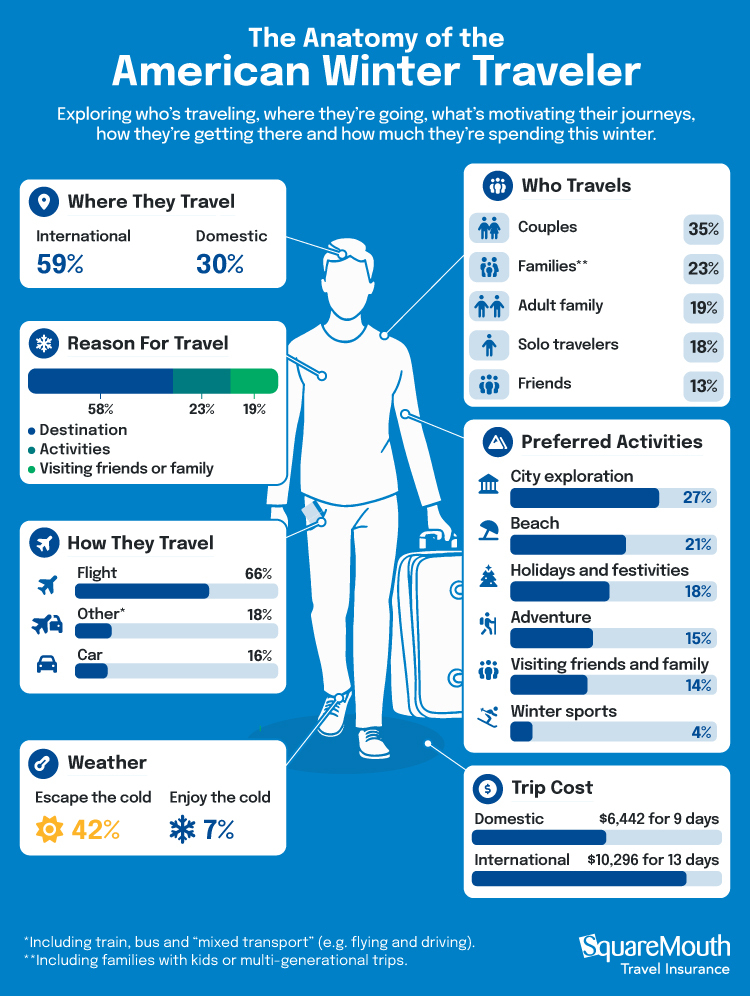
Travelers overwhelmingly take advantage of winter to travel abroad, as corroborated by both sales and survey data from Squaremouth customers.
In a recent survey from November 2026, we polled over 3,000 travelers on their winter travel plans.
66% said they were traveling abroad vs. 34% who planned to stay within the U.S., a proportion of roughly 2 to 1.
| Where Americans Are Traveling This Winter | Share of Responses |
| Traveling abroad | 66% |
| Traveling within the U.S. | 34% |
We also found that domestic and international trips have different primary drivers.
- Domestic winter travel is shaped primarily by family and holiday traditions:
- 32% of domestic travelers said their destination was determined by plans to visit family.
- Additionally, visiting family or friends (24%) and holiday festivities (22%) were the top reported travel activities domestically.
- International travel is driven by leisure:
- 63% of international travelers picked their destination first, then decided what to do after.
- City exploration (31%) and beach time (23%) are the most commonly planned travel activities.
These trips also differ by cost, with international travelers spending more time and money while away.
- Average domestic trip cost: $6,442.00 for 9.3 days
- Average international trip cost: $10,296 for 12.65 days
Top International Winter Travel Destinations
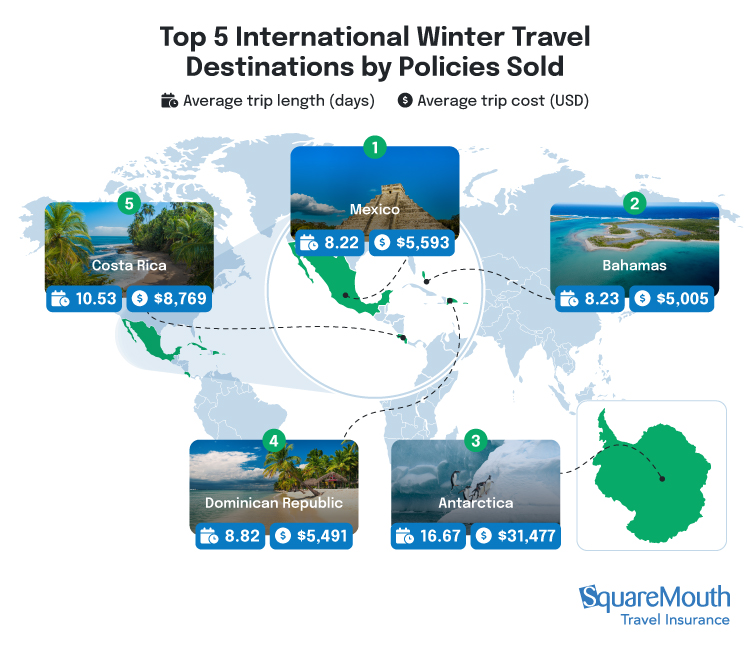
Nearly all of the top international destinations point to a clear trend: Americans heading abroad seek out warmer weather.
5 of the top 10 international destinations for winter travelers are nearby warm-weather locations:
When not prioritizing warm getaways close to home, our sales data shows that winter travelers most frequently seek out long-haul trips to the Southern Hemisphere, where seasons are reversed, and December to February are summer months.
| Rank (& YOY Change) | Destination | Average Trip Length | Average Trip Cost |
| 1 (0) | Mexico | 8.22 days | $5,593 |
| 2 (0) | Bahamas | 8.23 days | $5,005 |
| 3 (0) | Antarctica | 16.67 days | $31,477 |
| 4 (+1) | Dominican Republic | 8.82 days | $5,491 |
| 5 (+1) | Costa Rica | 10.53 days | $8,769 |
| 6 (+3) | New Zealand | 20.94 days | $16,366 |
| 7 (+1) | Aruba | 10.58 days | $6,003 |
| 8 (-4) | Argentina | 17.41 days | $16,989 |
| 9 (+7) | Egypt | 13.45 days | $16,181 |
| 10 (0) | Australia | 22.32 days | $17,863 |
4 destinations in the Southern Hemisphere rank among the top winter travel destinations for Americans this year, and these destinations coincide with a growing traveler focus on expedition and adventure travel: Antarctica, New Zealand, Argentina, Australia.
From this data, we can see that international winter travelers fall into 2 distinct groups:
- Warm Weather Getaways Close to Home, where trips last an average of 9.28 days and cost $6,172.
- Long-Haul Trips to the Southern Hemisphere, where trips last an average of 19.34 days and cost $20,674.
Travelers heading to the Southern Hemisphere stay twice as long and spend over 3 times more, and all of these destinations have expedition and adventure travel as a common denominator, which tracks with the rise in popularity for luxury travel we’ve seen this year.
Long-haul destinations also saw some of the biggest year-on-year changes in rankings.
- Egypt recorded the largest jump, moving up 7 places to 9th on the list of top international winter destinations.
- Argentina recorded the biggest fall, dropping 4 places to 8th. New Zealand climbed 3 places to 6th.
- Antarctica & Australia held their spots at No. 3 and No. 10, respectively. However, Antarctica’s average trip cost rose by $4,060 to $31,477.
Domestic Winter Travel Trends
Our recent survey found that roughly 1 in 3 travelers (34%) plan to stay domestically this winter, and Millennials are the most likely generation to stay stateside this winter (38%).
The data shows that winter domestic travel is largely centered around visiting friends or relatives and kids-centric holidays are most common among this group, all of which keeps these travelers closer to home.
- Visiting family or friends was the most common travel activity for domestic travelers, at 24% versus just 10% for international travelers.
- Domestic travelers were more than twice as likely to say their destination was determined by plans to visit family or friends than international travelers (32% vs 13%, respectively).
We also found that children were one of the strongest indicators of whether travelers stay domestic during winter trips.
- 38% of domestic travelers say their winter holidays revolve around kids, vs. 29% of international travelers.
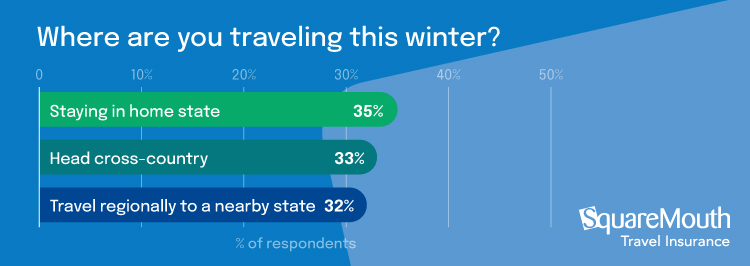
Two-thirds of domestic travelers (67%) plan to stay in state or travel regionally, while one-third plan to head cross-country:
- Stay in state (35%)
- Travel regionally to a nearby state (32%)
- Head cross-country (33%)
Despite a high number of travelers reporting in-state or regional travel, nearly half of all domestic travelers exclusively plan to fly to their destination.
Of Squaremouth customers who reported traveling domestically:
- 47% plan to fly
- 40% will travel primarily by car
- 11% expect to combine transport methods
This data is consistent with third-party reports of record air travel during this same period last year, and shows that domestic winter travel isn’t mostly road trips.
Sun Seekers vs. Snow Seekers
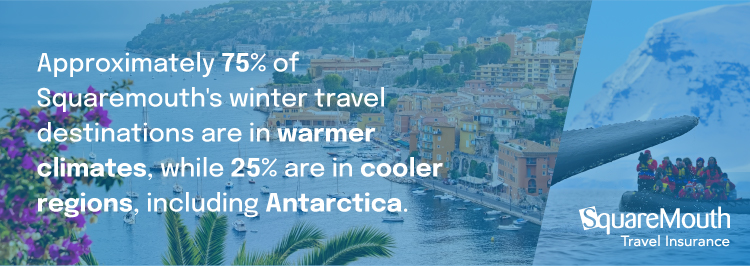
One of the most surprising data points we found is that winter trips aren’t always about winter.
We asked travelers if weather was a conscious factor when choosing where to travel this winter.
- 51% said weather wasn’t a factor
- 42% prioritized warm-weather destinations or activities
- Just 7% prioritized cold weather.
Of those who did consider weather, sun seekers were the overwhelming majority for both domestic and international travel:
| Weather Preference Determines Destination | Domestic Travelers | International Travelers |
| Prioritized warm weather destinations/activities | 84% | 87% |
| Prioritized cold weather destinations/activities | 16% | 13% |
Our internal sales data also corroborates this: 5 of the top 10 destinations abroad are nearby warm-weather getaways, and 4 more are Southern Hemisphere destinations where December through February is summer.
Snow seekers represent a very small group, with snow and winter sports accounting for just 6% of domestic and 4% of international planned activities among over 3,000 customers surveyed.
Similarly, we aimed to determine whether warm or cold weather activities dictated where people traveled to, or if the destination determined what people did while traveling.
Fewer than 1 in 4 chose their destination based on activities alone. 58% chose their destination first, and 23% chose it based on the activities they wanted to do.
| How Travelers Chose Their Winter Destination | Domestic Travelers | International Travelers |
| Chose the destination first, then planned activities | 47% | 63% |
| Chose the destination based on planned activities | 21% | 24% |
| Destination determined by visiting family or friends | 32% | 13% |
There’s a sharp contrast in what people get up to during their winter trips.
For international trips, travelers predominantly chose city exploration and visiting museums and historical attractions, which accounted for 31% of all international activity selections. This was followed by beach and water activities at 23%.
| Planned Winter Activities | Domestic Travelers | International Travelers |
| City exploration, museums, historical and cultural sites | 18% | 31% |
| Relax on the beach, sunbathe, snorkel | 17% | 23% |
| Hike, adventure expedition, explore nature | 12% | 16% |
| Holiday festivities, markets, food | 22% | 16% |
| Visiting family or friends, with activities secondary | 24% | 10% |
| Ski, snowboard, winter sports | 6% | 4% |
As mentioned, for domestic trips, visiting family or friends leads at 24%, followed by holiday festivities and markets at 22%.
“Skiing, snowboarding, and winter sports” was the least selected option of any available to survey respondents, even though respondents were able to select all options that applied.
This simply reiterates that winter travel is less about embracing winter weather and more about visiting family or escaping to warmer climates.
Winter Family Travel Trends
Despite winter coinciding with major holidays and time off from school and work, we found that this doesn’t translate to a large percentage of family trips during this period.
In fact, 68% of travelers surveyed said their winter holiday season does not revolve around kids, and only 15% reported travel plans involving children.
- 53% of winter travelers are going solo or as a couple, with couples’ trips being the most popular (35%).
Here’s a look at how travelers responded when asked who they were traveling with this winter:
| Who Are You Traveling With? | Percent Response |
| Going on a couples’ trip | 35% |
| Traveling with adult family members (no kids) | 19% |
| Solo trip | 18% |
| Going on a friends trip | 13% |
| Traveling as a family while kids are on winter break (parents & kids) | 11% |
| Taking a multi-generational trip with the whole family (kids, parents, & grandparents) | 4% |
How Winter Travel Changes by Generation
Whether or not kids set the tone for winter holiday travel plans is a dividing line between generations.
Age groups aligning with travelers in their parenting years were the most likely to say their holidays revolve around kids: Gen X (39%) and Millennials (37%), roughly 10 percentage points higher than Baby Boomers (28%).
Similarly, 29% of Millennials and 25% of Gen X report they plan to travel with children this winter, vs. only 7% of Baby Boomers.
| Generation | Winter Holidays That Revolve Around Kids | Traveling With Children | Traveling Abroad |
| Gen X | 39% | 25% | 67% |
| Millennials | 37% | 29% | 62% |
| Baby Boomers | 28% | 7% | 67% |
| Silent Generation | 26% | 4% | 64% |
Note: Gen Z is excluded from this table due to sample size and is covered separately below.
Senior Travelers: Winter Travel Trends
Squaremouth data shows seniors make up the largest portion of winter travelers, with the majority of these travelers seeking out international destinations.
- 67% of senior travelers surveyed reported plans to travel abroad this winter.
- Their top destinations are Mexico, the Bahamas, the Dominican Republic, Costa Rica and Antarctica.
Kids do not dictate the holiday travel season for seniors. Instead, they travel most often as couples (41%) or with their adult family members (24%).
- 72% of Baby Boomers and 74% of the Silent Generation report that their holiday season does not revolve around kids (grandkids).
- Solo travel is higher among the Silent Generation (22%) than among Baby Boomers (16%).
This group also takes the longest trips of any generational split. The average winter trip is 13.44 days and $10,173 for Baby Boomers, and 13.91 days and $10,469 for the Silent Generation.
Longer trips far from home make emergency medical and evacuation coverage especially important for this group.
Gen X: Winter Travel Trends
Like senior travelers, Gen X (ages 46 to 61) mostly seeks out trips abroad, with 67% of survey respondents in this age bracket reporting plans to head internationally this winter.
- Gen X’s top winter travel destinations largely mirror where senior travelers are headed, and include Mexico, the Bahamas, Antarctica, the Dominican Republic, and Costa Rica.
Gen X is also the generation most likely to say their holiday season revolves around the kids, at 39%. Both survey and policy sales data point to this generation traveling largely as families and couples.
- Couples’ trips are the most common (32%), followed by trips with children (25%).
- Sales data shows that Gen X’s international policies cover an average of 2.47 travelers, vs. just 1.87 for Baby Boomers, for example. This also suggests more families are traveling together.
As a whole, Gen X is made up of international-bound, family-focused households, and this generation likely spends more on trips as a result.
- With more travelers per trip, Gen X has the highest average insured international trip cost of any adult generation at $10,824, over 11.43 days. Domestic trips average $6,176 over 7.95 days.
How Millennials Are Traveling This Winter
Unlike older demographics, Millennials are the most domestic-leaning generation of winter travelers.
- 38% of Millennials surveyed report plans to stay stateside this winter, which was the highest of any generation.
- Of the 62% going abroad, the most popular destinations are Mexico, the Bahamas, and Antarctica.
37% of Millennials say their holiday season revolves around kids, putting them just behind Gen X respondents, but Millennials are more likely to actually travel with their kids over winter.
- 29% report plans to travel with children, as part of either multi-generational trips or as a nuclear family.
This is likely aligned with Millennials (30 to 45 years old) being at the prime age for parenthood. That said, not all Millennials are focused on family travel.
- More than half travel solo or as a couple (28% couples, 23% solo).
- This also tracks with a broader social trend for this age group, where, according to a 2025 Pew Research Center study, 12% of married couples with a spouse in their 30s or 40s are now dual-income with no kids, up from 8% in 2013.
As a whole, Millennials are split between family travel and kid-free travel abroad as a couple or solo traveler.
Millennials’ average insured international trip costs $9,702 over 10.97 days. Domestic trips average $6,853 over 7.26 days, with 3.12 travelers per policy, the largest domestic parties among the generations shown.
Gen Z Winter Travel Trends
Gen Z mostly travels in small groups, spends less per trip than any other generation, and shows an increasing interest in international travel.
- In the survey, 69% of Gen Z travelers are heading abroad, and Squaremouth sales data shows Gen Z international policy sales grew by 41% versus last winter, against 15% for domestic.
- Their most popular international destinations are Mexico, then Antarctica and the Bahamas (tied), Japan and Vietnam, making Gen Z the only generation with Asian destinations in its top 5.
Once again, our generational split shows travel trends aligning with stages of life. Where Gen X and Millennials are in prime parenthood years, Gen Z is at an earlier stage of life and mostly travels without family.
- Gen Z is the most likely to travel solo (39%) or with friends (26%), meaning nearly two-thirds travel without a partner or family.
Additionally, just 25% of Gen Z respondents say their winter holidays revolve around kids, the lowest of any generation, while 75% say they don’t.
- Only 5% of Gen Z travelers are traveling with children this holiday season.
Gen Z also takes more affordable winter trips and has the lowest average insured winter trip costs among adult generations. Gen Z’s international trips average $6,140 over 12.84 days and domestic trips $3,794 over 7.26 days. International policies cover an average of 1.56 travelers.
Importance of Travel Insurance for Winter Travel
Winter travelers face risks ranging from severe weather and canceled flights to medical emergencies and injuries during outdoor activities, depending on where and how they travel.
Our report on flight delays across the U.S. found that winter was the second-worst season for flight disruptions, with 24.0% of flights delayed or canceled. January recorded the highest monthly cancellation rate at 4.6%.
Squaremouth claims data shows just how expensive these disruptions and other travel emergencies can be:
| Travel Emergency | Average Traveler Claim Reimbursement |
| Illness | $3,165 |
| Injury | $3,172 |
| Inclement weather | $713 |
| Trip cancellation | $5,152 |
| Trip interruption | $2,226 |
| Travel delay | $446 |
These figures represent average insurance payouts, not the maximum amount an incident could cost a traveler. Actual expenses may be considerably higher.
Travel insurance can help reimburse eligible costs, but as seen in this report, diverse trip types, destinations, and travel activities mean relevant benefits can vary from trip to trip.
Here are our recommendations for winter travelers this 2026-2027 holiday season.
Traveling Internationally
U.S. health insurance plans offer limited or no coverage abroad, making emergency medical and evacuation benefits the most important considerations when heading out of the country.
Our data also shows the majority of international travelers this winter will be flying or have mixed itineraries, which increases the risk for travel disruptions like lost and delayed bags, missed connections, and more.
With insured overseas trips averaging more than $10,000, international travel insurance with trip cancellation protection is highly recommended. Travelers who need more flexibility should consider Cancel For Any Reason coverage, an optional benefit available with select policies that provides partial reimbursement when a traveler cancels for a reason not covered by standard cancellation benefits. Specific purchase deadlines and other eligibility requirements apply.
Traveling Within the U.S.
When traveling within the United States, domestic health insurance policies can usually cover medical treatment. That said, our data shows that nearly half of all domestic travelers will be flying to their destinations, so we recommend prioritizing a travel insurance policy that includes Travel Delay and Missed Connection coverage, as well as baggage loss and delay protection.
Expeditions, Hiking, & Snow Sports
Our data shows many winter travelers are seeking out adventure travel. 5 of the top 10 winter travel destinations abroad are adventure or expedition destinations (Antarctica, Costa Rica, New Zealand, Argentina and Australia), and hiking and adventure account for 16% of international activity selections. For these activities, it’s important to consider specialised action and adventure sports policies, as these types of activities can be excluded from standard travel insurance.
“Squaremouth offers one of the largest selections of policies that can cover action and adventure sports, which would otherwise be excluded by standard insurance plans,” says Chrissy Valdez, Senior Director of Operations at Squaremouth. “These policies can offer medical coverage for accidents and injuries, cover delayed or lost sports equipment, and even reimburse unused prepaid expenses such as ski lift tickets or lessons in some cases.”
We recommend comparing travel insurance plans and prices to find the right coverage for any upcoming travel
Data & Methodology
Squaremouth is the largest travel insurance marketplace in the United States. We help travelers compare travel insurance plans, prices, and coverage from multiple providers to find the best option for their needs.
This report combines our internal travel insurance sales and claims data, Squaremouth customer survey findings, national flight performance statistics, and additional external research to examine how Americans are planning their winter trips.
We analyzed our internal travel insurance sales data for U.S. residents with winter travel dates between December 2026 and February 2027, and compared the results with equivalent figures from winter 2025–26 where available.
The data set included thousands of policies purchased up to October 11, 2026. Policy sales refer to individual insurance policies, rather than travelers, as a single policy may cover multiple people.
Domestic vs. International Travel
We calculated the number and proportion of domestic and international travel insurance policies sold during each winter period, along with year-over-year changes. Average premiums, trip costs, trip lengths, booking lead times, and numbers of travelers are based on comprehensive policies only. Average figures were also checked against the country-level datasets.
Most Popular International Destinations
International destinations were ranked by the number of comprehensive travel insurance policies sold for each country for travel dates between December 2026 and February 2027.
Rankings are based on completed policy sales rather than insurance quotes. These rankings reflect Squaremouth’s policy sales rather than the total number of Americans visiting each destination. The United States and U.S. territories, including Puerto Rico and the U.S. Virgin Islands, were excluded from international rankings. Average international trip cost and length are weighted by policy count and exclude U.S. territories.
For the comparison between nearby warm-weather destinations (Mexico, the Bahamas, the Dominican Republic, Costa Rica and Aruba) and Southern Hemisphere destinations (Antarctica, New Zealand, Argentina and Australia), average trip length and cost are the simple (unweighted) averages of each group’s destination-level averages.
Travel by Generation
We analyzed Squaremouth policy sales by generation, including each generation’s share of international policies and year-over-year changes in policy sales. These comparisons include total policies, whereas average premiums, trip costs, trip lengths, booking lead times and numbers of travelers were assessed using comprehensive-policy data only.
To identify each generation’s 5 most popular destinations, we grouped comprehensive-policy sales by generation and destination country, then ranked destinations by sales volume.
We analyzed data from over 2,500 travel insurance claims, ranking claim categories by the number of claims made. Each category’s share was calculated against the total number of claims. We also reviewed the average amount paid per claim to identify the most common types of claims and their associated costs.
Flight disruption statistics were sourced from Squaremouth’s October 2026 report,The U.S. States Where Your Flight Is Most Likely to Be Delayed.
The report analyzed Bureau of Transportation Statistics (BTS) data covering July 2025–June 2026, including flight delays and cancellations by state, airport and month.
Flight disruption rates represent the percentage of scheduled flights delayed or canceled. Seasonal comparisons were calculated using the same reporting period. The report also analyzed Squaremouth’s internal Tin Leg travel insurance claims data to assess the average payouts associated with trip cancellations, trip interruptions and travel delays.
In November 2026, Squaremouth surveyed over 3,000 Squaremouth customers about their travel plans for December 2026 to February 2027. The survey covered planned destinations, travel companions, transport choices, activities, and factors influencing destination decisions.
Respondents could indicate that they were not traveling this winter. Non-travelers are excluded from the domestic vs. international split, which is based on the respondents who are traveling. Response totals varied by question, with percentages calculated using the responses received for each question.
Survey responses were also analyzed by plans to travel domestically versus internationally, by generation, and by whether respondents agreed that their winter holidays revolve around kids, to identify differences in destination choices, activities, transport methods, travel companions, and attitudes toward family-focused winter holidays.
Due to reduced sample size, Gen Z survey figures are shown as directional metrics only, and Gen Z was excluded from the chart comparing survey responses by generation.
For questions allowing 1 answer, percentages represent the share of respondents to that question within the relevant group. For questions allowing multiple activity selections, percentages represent the share of total selections rather than individual respondents. The weather-preference comparison excludes respondents who said weather wasn’t a factor, calculating the warm-versus-cold split among those who prioritized either condition.
Percentages are rounded to the nearest whole number and may not total 100%.