Senior Cruise Report: Costs, Insurance Trends & Travel Priorities for Travelers 65+

According to our proprietary data, 95% of seniors (65 or older) taking a cruise in 2026 are repeat cruise-goers.
To better understand how this experienced segment structures and protects their cruise travel, we analyzed our internal policy sales data and customer survey responses from travelers aged 65+.
Our analysis examined factors like senior cruisers’ average trip cost, budget preferences, trip lengths, destination patterns, coverage selections, and purchase timing to highlight how these consumers’ purchase patterns influence cancellation eligibility, medical protection, and the overall cost of cruise insurance premiums.
Our analysis found that senior travelers take longer and more expensive cruises than younger demographics and have a higher propensity to splurge despite reporting price sensitivity.
Despite higher trip costs and longer travel times, senior cruisers value cancellation protection less than younger travelers, reporting a higher preference for medical insurance. That said, half of senior travelers miss out on important protections like coverage for pre-existing medical conditions due to their purchase habits, and 32%-35% of seniors opt for inadequate medical limits when buying cruise insurance.
Here is a closer look at the key data points.
Key Data Points:
- On average, seniors spend roughly $1,500 more per cruise than younger travelers and have an average cruise vacation cost of $6,942.
- Despite showing an overwhelming preference for spending less than $5,000 per cruise, our data show that the average senior ends up spending nearly $2,000 more than their preferred budget.
- In line with their increased spending, the majority of senior cruisers surveyed say they are moderately concerned about rising cruise costs and added fees in 2026.
- 80.6% of senior cruisers go on trips lasting longer than 7 days, and they are twice as likely to book cruises lasting 15–30 days as younger travelers.
- Seniors prefer cruise routes closer to home, with the top senior cruise travel destinations being Mexico, the United States, and the Bahamas, accounting for 57.2% of all senior cruise insurance policies sold.
- Despite longer trips and higher costs, a significant number (23.9%) forgo comprehensive travel insurance plans with trip cost reimbursement, putting them at risk of significant financial losses.
- Medical coverage is the top priority for seniors, but over a quarter of senior cruisers purchase policies with inadequate medical limits.
- Nearly half of all seniors buy their policies too late and miss out on important benefits, such as pre-existing condition coverage and Cancel For Any Reason (CFAR), leaving them susceptible to policy exclusions if forced to make a claim.
For the full data set covering destinations, trip lengths, lead times, coverage types, and survey results, please contact media@squaremouth.com
The Average Senior Spends Around $7,000 Per Cruise
Squaremouth policy sales data show that the typical cruise costs $6,942 for senior travelers aged 65 and over, roughly $1,500 more on average than younger travelers.
This number reflects the entire trip cost, including additional expenses such as a traveler’s flights, hotels, excursions, and more.
Our analysis revealed that although seniors spend more on average, there is a disparity between their actual spending and their reported ideal budget.
The data shows that seniors spend far more than they would prefer to on cruises and report a growing concern over the rising cost of cruises. That said, the data revealed time and time again that despite their concerns and spending preferences, seniors show a greater propensity to splurge on longer and more expensive cruises than younger travelers.
At nearly $7,000 per trip, having cancellation and interruption coverage should be an important consideration for seniors. However, our data show that over a quarter of senior cruisers (23.9%) forgo comprehensive coverage and opt for medical-only policies instead.
Our recent industry report on the cost of cruise insurance also shows that older travelers opt for longer cruises. As trip cost and duration increase, premiums typically rise due to age-based pricing and extended coverage periods.
Seniors Spend More Than They Wish On Cruises
We surveyed Squaremouth customers and found that the average senior cruiser spends around $2,000 more than their preferred budget range.
What Is Your Preferred Budget Range for a 7-Night Cruise?
| Preferred Cruise Budget Range | Travelers (Aged 64 & Under) | Travelers (Aged 65 & Over) |
|---|---|---|
| $1,000–$2,000 | 25.5% | 17.4% |
| $2,000 – $3,000 | 25.4% | 16.7% |
| $3,000 – $4,000 | 16.6% | 20.1% |
| $4,000 – $5,000 | 15.0% | 14.5% |
| $6,000 – $7,000 | 5.4% | 9.7% |
| $7,000 – $8,000 | 4.0% | 6.5% |
| $8,000 – $9,000 | 1.6% | 3.7% |
| $9,000 – $10,000 | 2.3% | 3.8% |
| Over $10,000 | 4.2% | 7.7% |
Some percentages may not add up to 100% due to rounding.
Nearly 70% of senior cruisers (68.7%) target budgets under $5,000 for a 7-night cruise.
However, the survey showed that the most commonly preferred price range was $3,000–$4,000 for a cruise vacation. This highlights a $2,000 gap between seniors’ preferred budgets and their actual average trip cost.
Senior cruisers’ willingness to splurge versus that of younger cruisers could account for why actual cruise spending often exceeds initial expectations and why seniors cite elevated concern about rising cruise costs.
Seniors Express Elevated Concern About Rising Cruise Costs
In a recent survey, we asked cruisers how concerned they were about cruise costs or added fees (gratuities, excursions, fuel surcharges, etc.) rising in 2026.
Over 42% of seniors say they are moderately concerned about rising cruise costs in 2026 versus only 38.8% of younger travelers.
How Concerned Are You About Rising Cruise Costs or Added Fees for 2026?
| Level of Reported Concern | Travelers Aged 64 & under | Travelers Aged 65 & over |
|---|---|---|
| Moderately Concerned | 38.8% | 42.4% |
| Not Concerned | 8.9% | 6.6% |
| Slightly Concerned | 15.4% | 13.9% |
Some percentages may not add up to 100% due to rounding.
This sentiment data is further reinforced by the fact that older cruisers already tend to pay nearly $2,000 more on average for cruise vacations than their ideal price point.
Therefore, the disparity between preferred budgets and actual spend clearly aligns with seniors’ elevated concerns about rising cruise vacation costs in 2026.
Seniors are More Comfortable Splurging on Cruises than Younger Generations
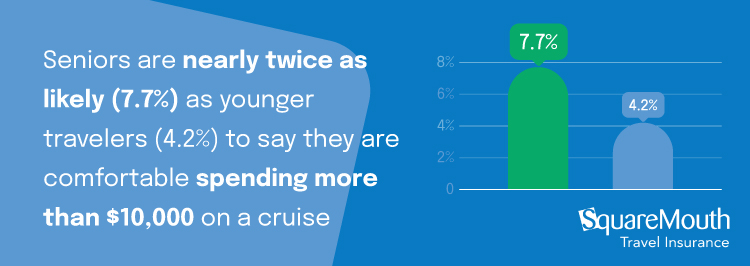
Seniors consistently report a greater willingness to spend more on cruises than younger travelers.
Starting with low budgets, nearly 50% of young respondents cited that they wanted to spend under $3,000, as compared to just 35% of seniors.
Additionally, as budgets rose, seniors consistently showed more willingness to pay higher amounts than younger travelers across all budget ranges over $6,000.
The data show that seniors are nearly twice as likely to say they are comfortable spending more than $10,000 on a cruise versus younger travelers (7.7% vs. 4.2%).
Older travelers are not just more comfortable splurging on higher-priced cruises; they are also more likely to book longer trips than younger demographics.
Over 80% of Seniors Cruise for More Than One Week
The average cruise duration for travelers 65 and older is 15 days, compared to just 11 days among younger travelers, with both demographics preferring cruises lasting 8-14 days.
However, longer itineraries are about twice as common among seniors:
- Seniors are twice as likely to take cruises lasting 15–30 days versus younger travelers (33.3% vs 17.62%).
- For cruises lasting a week or less, seniors book at nearly half the rate of younger travelers (19.4% vs 34.09%).
| Trip Length | Policies Sold (Ages 64 & under) | Policies Sold (Ages 65 & over) |
|---|---|---|
| ≤ 3 Days | 2.30% | 0.8% |
| 4-7 Days | 31.79% | 18.6% |
| 8-14 Days | 46.07% | 41.4% |
| 15-30 Days | 17.62% | 33.3% |
| 30-60 Days | 1.57% | 4.7% |
| 61-90 Days | 0.27% | 0.5% |
| 91-180 Days | 0.13% | 0.3% |
| 181-365 Days | 0.03% | 0.0% |
| 365+ Days | 0.23% | 0.4% |
Some percentages may not add up to 100% due to rounding.
Across both cruise spending and cruise length, older travelers consistently show a greater propensity to commit to higher-priced itineraries.
Seniors’ tendency to choose longer itineraries at higher price points suggests that greater time flexibility due to retirement and stable financial situations may allow them to plan longer, more expensive cruises.
That said, seniors show an overwhelming preference to take cruises closer to home versus younger generations.
Senior Cruisers Prefer Traveling Closer to Home
Even though seniors tend to book longer cruises, their destination choices remain heavily concentrated in locations in and around the United States.
Squaremouth data shows that Mexico, the United States, and the Bahamas account for 57.2% of all cruise policies sold to travelers aged 65+,
Bookings for each of these destinations significantly outpace long-haul alternatives like cruises in Europe and Asia, despite seniors having the extra time and money needed for these destinations.
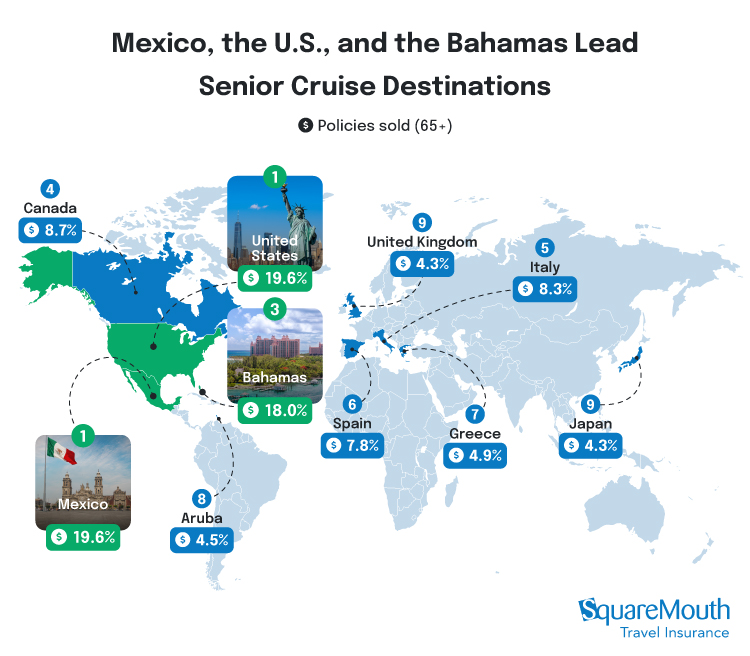
Seniors’ preference for cruises in North America and the Caribbean is especially clear when compared to policy sales for Europe.
The data suggests that seniors are roughly three times more likely to take a cruise to the Bahamas than to destinations such as the United Kingdom or Greece, and over twice as likely to visit the Bahamas than to go to Spain or Italy.
Cruise Amenities: Onboard Priorities & Preferences Among Senior Cruisers
As a consumer group, our data has established that Senior travel trends are markedly different from those of younger generations in terms of budgets, spending, trip length, and preferred destinations.
We surveyed senior cruisers to gain further insight into this segment’s consumer behavior and understand what senior cruisers value most when selecting cruise vacations.
Seniors Value Onboard Inclusions, But Drinks Packages Show the Clearest Age Divide
Dining is the top priority across all senior age groups, with at least 84% of travelers in their 50s through 70s selecting meals as a key onboard inclusion, rising to 90.2% among travelers 80+.
| Which Onboard Inclusions Matter Most to You? | 50s | 60s | 70s | 80s |
|---|---|---|---|---|
| Meals and Dining Options | 86.4% | 86.2% | 84.0% | 90.2% |
| Wi-Fi Access | 60.5% | 60.9% | 60.4% | 58.5% |
| Onboard Activities (Classes, Lectures, Shows, Entertainment) | 54.8% | 53.8% | 47.4% | 58.5% |
| Shore Excursions | 51.0% | 58.4% | 58.4% | 43.9% |
| Relaxed Social Spaces or Lounges | 48.6% | 43.1% | 48.6% | 54.9% |
| Drinks Package | 41.5% | 38.5% | 26.2% | 22.0% |
| Wellness Facilities | 20.8% | 22.2% | 19.2% | 13.4% |
| Assistance Services | 7.1% | 6.1% | 7.5% | 14.6% |
Respondents chose all that applied, so percentages do not add up to 100%.
Our internal survey data shows preferences begin to diverge across some inclusions as travelers age:
- Drink packages decline steadily with age, falling from 41.5% in travelers in their 50s to 22.0% among those 80+, making them less commonly prioritized among older travelers.
- Wi-Fi access is the second most important on-board cruise amenity for seniors, with consistent numbers (roughly 60%) across all age groups. Although this may sound surprising, this finding is consistent with external AARP research, which shows that older adults increasingly rely on digital tools and connectivity while traveling.
- Assistance services are more than twice as important to travelers 80+ (14.6% vs. 6%-7% in younger groups), indicating a clear increase in demand for support-related features later in life.
- Wellness facilities trend downward with age, dropping from 22.2% in travelers in their 60s to 13.4% among those 80+, making them the least prioritized inclusions overall.
Cruise Accessibility Needs Double With Age, as Mobility Becomes Top Priority for Seniors
As part of our survey of Squaremouth customers, we aimed to understand which accessibility factors seniors consider when taking cruises and how this differs by age group.
Versus onboard inclusions, accessibility priorities shift more noticeably by age.
| Which Accessibility Features Are Most Important to You When Booking a Cruise? | 50s | 60s | 70s | 80s |
|---|---|---|---|---|
| Priority Boarding and Disembarkment | 63.8% | 63.2% | 56.1% | 57.1% |
| Onboard Medical Facilities | 45.6% | 35.8% | 40.9% | 35.7% |
| Accessible Elevators and Proximity to Cabins | 26.9% | 21.8% | 33.0% | 48.2% |
| Accessible Public Spaces (Dining and Activity Areas) | 26.2% | 25.3% | 29.6% | 51.8% |
| Assisted Shore Excursions or Mobility Support Staff | 10.7% | 7.0% | 10.0% | 14.3% |
| In-Room Accessibility Aids (Adjustable Beds, Non-Slip Flooring, Seating Support in Bathrooms) | 9.4% | 8.4% | 9.1% | 12.5% |
| Wheelchair or Mobility-Accessible Cabins | 8.7% | 5.3% | 8.3% | 19.6% |
Respondents chose all that applied, so percentages do not add up to 100%.
Priority boarding and disembarkment are by far the most important accessibility features valued by senior travelers across all age groups.
Accessibility priorities by age group vary the most about movement and navigation within the ship.
- Accessible public spaces become nearly twice as important with age, rising from 26.2% among travelers in their 50s to 51.8% among those 80+.
- Elevator access and cabin proximity follow the same trajectory, rising from 26.9% to 48.2% across the same age groups.
Other accessibility features show more stable demand, with onboard medical facilities remaining a consistent priority, ranging from 35% to 46% across all senior groups.
Some features only become more relevant in older age groups. Wheelchair-accessible cabins double in importance among travelers 80+, reaching 19.6%, compared with under 9% among younger seniors.
Consumer Behavior Trends: Cruise Travel Insurance for Seniors
As a consumer group, senior travelers have higher-than-average trip costs for cruise vacations and also spend more time away on their trips, leading to an increased risk of travel mishaps and potential financial losses.
Despite increased trip costs, a significant number of seniors (23.9%) choose to forgo cancellation & interruption coverage and focus on medical-only protection.
For example, when compared to younger travelers, seniors are more likely to prioritize pre-existing condition coverage and less likely to purchase expanded cancellation flexibility.
Additionally, despite favoring convenience factors when booking cruises, most seniors forgo opting for convenience benefits found within travel insurance policies, like cancellation, interruption, and CFAR coverage.
The higher price of comprehensive policies could be a determining factor in seniors shying away from important trip cancellation and interruption coverage, as this trend aligns in part with senior cruisers’ elevated concern for rising cruise costs and desire to spend less on cruises.
Below is a closer look at the cruise travel insurance habits of seniors, as well as important gaps we discovered between consumer behaviour and sentiment versus purchase habits.
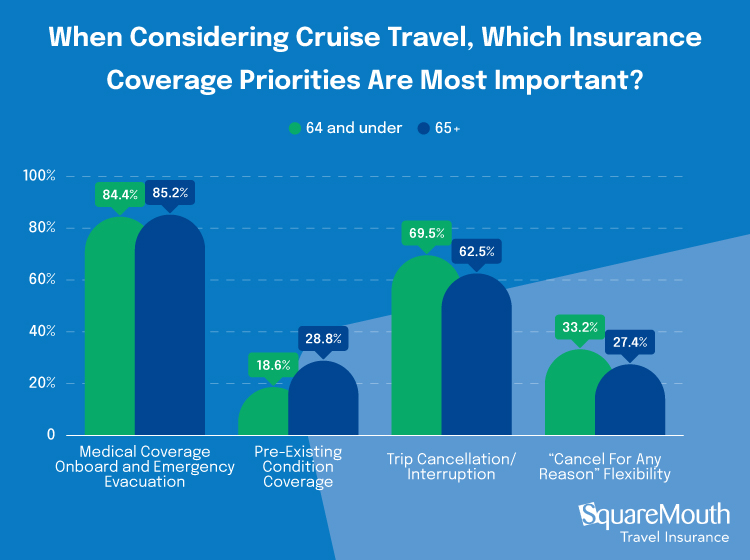
Respondents chose all that applied, so percentages do not add up to 100%.
Emergency Medical & Evacuation Coverage Is a Top Priority Among Senior Cruisers
In a recent survey of Squaremouth customers, senior cruisers were asked which travel insurance coverages were most important to them for cruises.
- Emergency Medical and evacuation coverage ranks highest among senior cruisers (85.2%), closely mirroring the preferences of travelers under 65 (84.4%).
- Pre-existing condition coverage shows the largest age-based gap. 28.8% of seniors prioritize coverage for pre-existing medical conditions as compared to 18.6% of younger travelers.
- The survey showed that Trip Cancellation coverage is prioritized by 62.5% of seniors, lower than the reported 69.5% of younger travelers.
This comes as a surprise, as senior travelers have higher trip costs than younger travelers and, therefore, should theoretically be more inclined to protect these with comprehensive trip cancellation coverage.
This lack of prioritization of cancellation protection also carried over into Cancel For Any Reason coverage, which the survey revealed is prioritized by only 27.4% of seniors, as compared to 33.2% of younger travelers.
Without any form of cancellation coverage, reimbursement for non-refundable prepaid expenses depends on other protections, such as cruise line policies or credit card benefits, which may have narrower terms or only provide future cruise credits instead of cash refunds.
Seniors Prioritize Medical-Only Coverage, But Often Lack Sufficient Coverage Limits
When analyzing internal sales data, we see that despite 85.2% of seniors prioritizing medical coverage above all else, they misunderstand the level of coverage needed for adequate protection while on a cruise.
For example, our data shows that 32% of senior cruisers purchase less than the minimum recommended limits of $100,000 of Emergency Medical coverage for cruise vacations.
This trend is also seen with 35% of seniors purchasing less than the recommended $250,000 of Medical Evacuation coverage.
These coverage thresholds reflect the actual cost of care in cruise scenarios.
Onboard treatment is typically paid out of pocket, as the U.S. Department of State specifies that most domestic health insurance plans, including Medicare, are not accepted outside of the United States. If more advanced care is required, travelers may need to be transported to a land-based hospital, as ships are not equipped to handle all medical situations.
According to the CDC, these medical evacuations can exceed $250,000 depending on the location and level of care required. Coverage below these levels may leave travelers responsible for high out-of-pocket costs, especially on itineraries that are far from major medical facilities.
Half of Seniors Miss Out On Time-Sensitive Insurance Benefits Due to Lack of Urgency
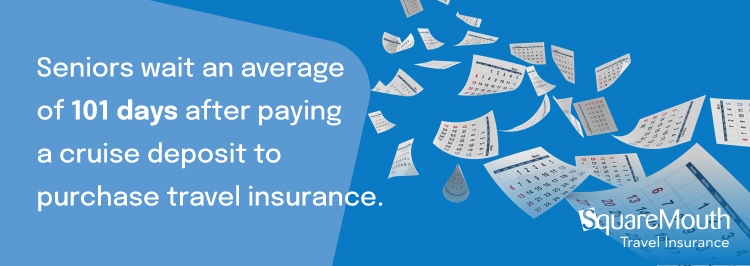
Our data shows that half of cruisers age 65 and older miss out on time-sensitive benefits like CFAR and pre-existing condition coverage because they wait too long to buy travel insurance.
These benefits usually require travelers to buy coverage within 14 to 21 days of their initial trip payment, depending on the policy, and 49.4% wait until after this period to buy coverage.
85.2% of seniors surveyed cite medical coverage as their top priority when buying trip protection, but Squaremouth sales data reveals that around half of all senior cruisers are ineligible for coverage for flare-ups of pre-existing conditions, despite purchasing travel medical protection.
Without pre-existing condition coverage, seniors who present unstable medical conditions during the policy’s lookback period (anywhere from 60-180 days pre-purchase) will have their medical coverage voided for claims related to a flare-up or treatment of a pre-existing condition.
Apart from pre-existing condition coverage, half of seniors also miss out on Cancel for Any Reason Coverage. Seniors have the highest trip costs among all travel groups, putting them at greater financial risk of loss if they need to cancel for a reason not covered by a standard policy. Even with trip cancellation protection, there are certain events that have become commonplace in 2026 that are excluded unless you have CFAR protection.
Recent events like the government shutdowns, increased military actions, and airspace closures have all been excluded from standard cancellation coverage. By simply purchasing travel insurance soon after making their initial trip deposit, seniors can gain access to these important benefits.
Expert Insight: What Senior Cruisers Should Consider and Why Insurance Decisions Matter After 65
Chrissy Valdez, Senior Director of Operations at Squaremouth, says cruise planning priorities shift after age 65, and those shifts have direct insurance implications:
“Senior cruisers are booking longer and more expensive trips, but many are unaware or ignoring industry experts’ coverage recommendations. We consistently see gaps in both medical and cancellation protection.
Medical coverage is especially important for this group. Domestic health insurance, including Medicare, typically does not apply abroad, and a medical evacuation from a cruise can cost more than $250,000. At a minimum, travelers should look for policies with at least $100,000 in Emergency Medical coverage and $250,000 in Medical Evacuation coverage.
Timing is equally important. More than half of senior cruisers (55%) miss out on key benefits because they wait too long to buy a policy. To access options like pre-existing condition waivers or Cancel For Any Reason coverage, travelers typically need to purchase insurance within 14 to 21 days of their initial trip deposit.
At the end of the day, if the cost of a comprehensive policy is your biggest concern, we recommend reaching out to our team of agents. They can help you prioritize the benefits that matter most for your trip, without leaving you vulnerable.”
Methodology & Data
We are Squaremouth, a leading U.S. travel insurance comparison site helping travelers find coverage that fits their specific trip. Our platform allows customers to compare policies from multiple providers side-by-side, filtering by benefits such as trip cancellation, medical coverage, emergency evacuation, and optional upgrades.
Given the financial exposure associated with cruise travel, we analyzed Squaremouth policy sales data and survey responses to better understand how seniors budget, insure, and prioritize coverage for their cruises.
The findings are based on the following methodology and data sources:
Data on average destination, trip length, lead time, cost, and coverage type for travelers aged 65 and over were sourced from Squaremouth data.
All data relates to the period from 1/1/2025 to 1/1/2026 and to policies sold to travelers aged 65 and over.
We also conducted two surveys of travelers, which ran between 12/30/25 and 2/10/26.
For the full data set covering destinations, trip lengths, lead times, coverage types, and survey results, please contact media@squaremouth.com